Historic pubs
London’s historic pubs
342 notable pubs, cited from Wikipedia and Wikidata. Never invented. Data credits
Showing 1-24 of 342 pubs
Founded 1520
Prospect of Whitby
Tower Hamlets, Grade II*
The Prospect of Whitby is a Grade II* listed pub on Wapping Wall in the East End, reputed to be one of the oldest riverside taverns in London, dating from around 1520.
Founded 1583
The Grapes
Tower Hamlets, Grade II
The Grapes is a Grade II listed public house at 76 Narrow Street, Limehouse, on the north bank of the Thames; a pub has stood on the site since 1583.
Built 17th c.
The Hoop and Grapes
City of London, Grade II*
The Hoop and Grapes at 47 Aldgate High Street is a Grade II* listed pub, probably built in the late 17th century; it is one of the very few timber-framed buildings in the City of London to survive from that period, standing just beyond where the Great Fire of London was halted in 1666.
Built 17th c.
The Seven Stars
Camden, Grade II
The Seven Stars is a Grade II listed pub at 53 Carey Street behind the Royal Courts of Justice; with 17th-century origins (its frontage bears the date 1602), it is one of the few City-fringe pubs to have survived the Great Fire of London.
Built 1667
The Tipperary
City of London, Grade II
The Tipperary is a Grade II listed pub at 66 Fleet Street; the building was built in about 1667, and the wood-panelled pub is widely reputed to be one of London's oldest Irish pubs.
Built 18th c.
The Dickens Inn
Tower Hamlets
The Dickens Inn at St Katharine Docks occupies an 18th-century timber-framed former warehouse; when the docks were redeveloped in the 1970s the structure was moved bodily to its present site and reopened as a three-storey balconied inn.
Founded 18th c.
The Nellie Dean
Westminster, Grade II
The Nellie Dean of Soho is a Grade II listed pub at 89 Dean Street, Soho; the present building dates from 1900 and there has been a pub on the site since the 18th century.
Built 18th c.
The Perseverance
Camden, Grade II
The Perseverance at 63 Lamb's Conduit Street, Bloomsbury, is a Grade II listed building of early-18th-century origin, refronted in the early 19th century; it traded for years as The Sun before taking its current name.
Built 18th c.
Founded 1736
The Crown & Two Chairmen
Westminster
The Crown & Two Chairmen at 31-32 Dean Street, Soho, has had a pub on the site since 1736; the present building was rebuilt in 1929 and the name is said to recall two sedan-chair men who drank here while Queen Anne sat for a portrait opposite.
Built 19th c.
The Pride of Spitalfields
Tower Hamlets
The Pride of Spitalfields at 3 Heneage Street, just off Brick Lane in the East End, is a mid-19th-century pub formerly known as the Romford Arms; it sits in the old Huguenot heartland of Spitalfields and was named CAMRA's East London Pub of the Year in 2013.
Built 19th c.
The Star Tavern
Westminster, Grade II
The Star Tavern is a Grade II listed pub at 6 Belgrave Mews West, Belgravia, of early-to-mid-19th-century origin; in the 1950s and 1960s it drew both high society and the London underworld, and it is reputed to be where the 1963 Great Train Robbery was planned.
Built 1846
The Bulls Head
Richmond upon Thames
The Bull's Head at 373 Lonsdale Road, Barnes, is a riverside Young's pub whose present building dates from 1846; it opened as a jazz venue in 1959 and, hosting leading British and international musicians, became known as the 'suburban Ronnie Scott's'.
Founded 1846
Founded 1849
Built 1850
The Rugby Tavern
Camden, Grade II
The Rugby Tavern on the corner of Great James Street and Rugby Street, Bloomsbury, is a Grade II listed pub dating from about 1850, built on land that forms part of the Rugby (School) Estate.
Built 1855
Museum Tavern
Camden, Grade II
The Museum Tavern is a Grade II listed pub at 49 Great Russell Street, opposite the British Museum; the present building was rebuilt around 1855-64 by William Finch Hill, and Karl Marx is traditionally said to have drunk here while working in the nearby Reading Room.
Built 1875
The Blackfriar
City of London, Grade II*
The Black Friar is a Grade II* listed pub at 174 Queen Victoria Street, Blackfriars, built about 1875 on the site of a medieval Dominican (Black Friars) friary and remodelled around 1905 by the architect Herbert Fuller-Clark; it is famous for its Arts and Crafts and Art Nouveau interior of marble, mosaic and bronze reliefs of jovial friars.
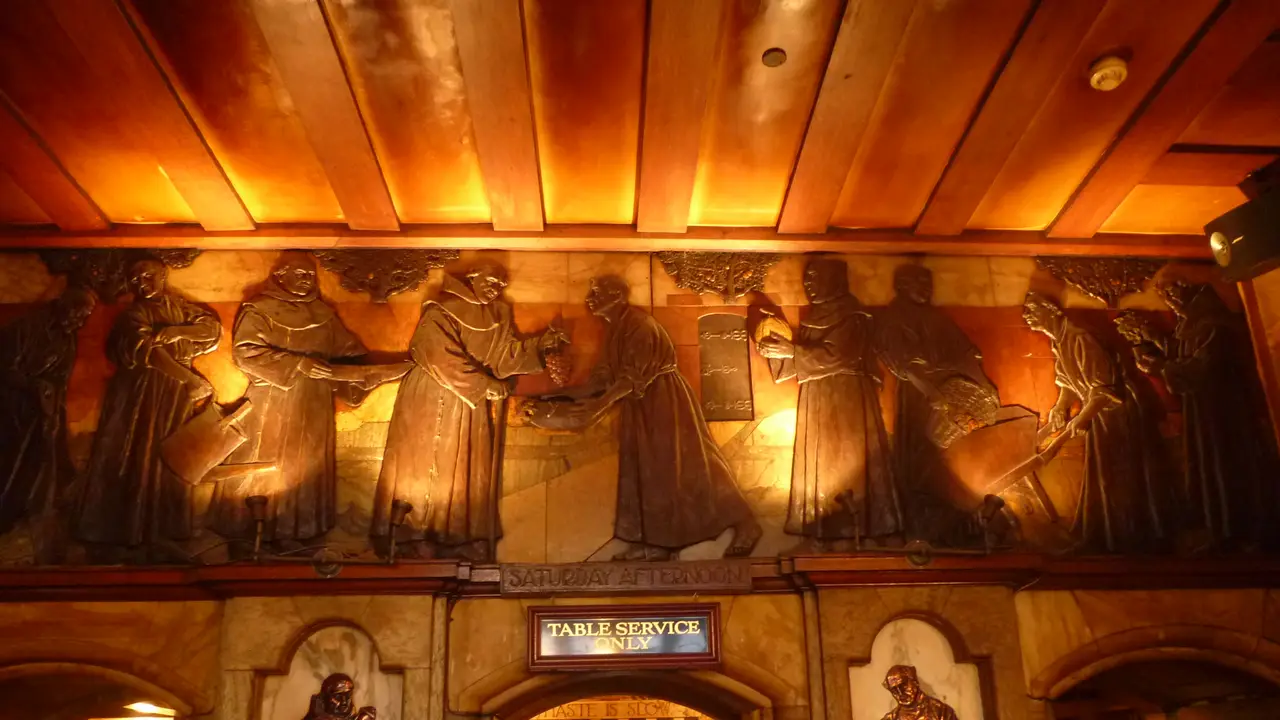
Photo: Love Art Nouveau, CC BY 2.0
Built 1886
The Old Bank of England
Westminster, Grade II
The Old Bank of England is a Grade II listed pub at 194 Fleet Street, built in 1886 by Sir Arthur Blomfield; it housed the Law Courts branch of the Bank of England from 1888 to 1975 before becoming a pub in 1994.
Built 1888
The Audley
Westminster, Grade II
The Audley at 41-43 Mount Street, Mayfair, is a Grade II listed pub built about 1888 to designs by the architect Thomas Verity; a grand late-Victorian building of red brick and pink terracotta, it was rebuilt on the Grosvenor (Duke of Westminster) estate and retains fine mahogany panelling and a carved bar-back.
Built 1897
The Dog & Duck
Westminster, Grade II
The Dog and Duck at 18 Bateman Street, Soho, is a Grade II listed pub; the current building dates from 1897 and its upstairs dining room is named after the writer George Orwell, who was a regular.
Built 1899
Salisbury
Westminster, Grade II
The Salisbury at 90 St Martin's Lane, Covent Garden, is a Grade II listed pub built about 1899; its lavish late-Victorian interior of etched and polished glass, mahogany and Art Nouveau candelabra is listed on CAMRA's National Inventory as a historic pub interior of national importance.
Built 1901
Ye Olde Watling
City of London
Ye Olde Watling stands at 29 Watling Street, on the line of the old Roman road of the same name, close to St Paul's Cathedral; the timber-framed pub is traditionally said to have been rebuilt for Sir Christopher Wren's workmen after the Great Fire of London, and its present old-world interior largely dates from a sympathetic refit of about 1901.
Built 1903
The Coal Hole
Westminster, Grade II
The Coal Hole is a Grade II listed pub at 91 Strand, part of the Savoy Court development, built in 1903-04 to the design of architect T. E. Collcutt.

Pint price time machine: what a pint cost at London pubs in past years, from dated reviews.